https://www.youtube.com/watch?v=DiWjIopJQ4Y
Showing posts with label Jesus. Show all posts
Showing posts with label Jesus. Show all posts
Fake story: John 8:7 "Let anyone among you who is without sin be the first to throw a stone " forgery; Woman caught in adultery in earliest manuscripts !

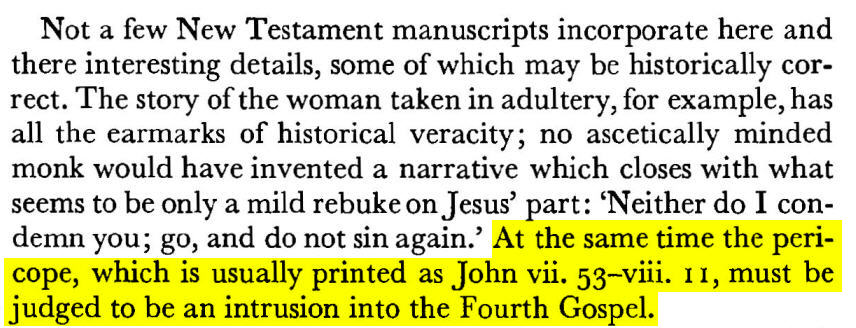
There is general agreement that the verses from John 7:53 to John 8:11 were not written by the author or authors who wrote the rest of the gospel. There is little consensus as to exactly when the forgery was inserted.
Chris Keith is professor of New Testament and Early Christianity at St Mary's University where he also serves as Director of the Centre for the Social-Scientific Study of the Bible.
The story of the woman caught in adultery, typically located at John 8:1-8:11, is one of the most popular stories in the entire Bible. Jesus’ lack of condemnation of a known sinner captivates some readers, as does his statement “Let anyone among you who is without sin be the first to throw a stone at her” (John 8:7) and the manner in which he outwits the scribes and the Pharisees with that statement. Since, as his opponents note (John 8:5), the law of Moses demanded that an adulteress be killed, Jesus’ opponents have thrust him upon the horns of a dilemma. He has to choose either to allow the woman to go free and publicly disobey the law of Moses or to approve of her killing and forfeit his reputation as a friend to sinners (and possibly risk trouble with Rome for contributing to a capital punishment that they had not sanctioned). The cleverness of Jesus’ response in John 8:7 is that it renders the enactment of the legal punishment impossible without requiring his public disavowal of the law.
Interestingly enough, the earliest manuscripts of the Gospel of John do not contain this beloved passage. Indeed, the first manuscript to contain the story is from around 400 C.E. Around 4% of Greek manuscripts that include the passage place it in locations other than John 8:1-8:11; the earliest of these is from around the ninth and tenth centuries C.E. This perplexing manuscript history fuels debates about whether the story was originally in John’s Gospel and, if so, where. The majority of scholars believe a later Christian scribe inserted the passage into John’s Gospel at John 8:1-8:11 and that the alternate locations are due to the effects of later liturgical reading in what is known as the lectionary system. [ Chris Keith, "Manuscript History and John 8:1-8:11", n.p. [cited 21 Apr 2017]. Online: http://www.bibleodyssey.org/en/passages/related-articles/Manuscript History and John].
The text of the New Testament : It’s Transmission Corruption and RestorationSecond Edition By Bruce M. Metzger Page 223

Manuscripts that doesn’t conain the story:
( p66 , p75 , א , B , L , N , T , W , X , Δ , Θ , Ψ , 33 , 157 , 565 , 892 , 1241 )
.
Daniel B. Wallace* on the fake story:
https://www.youtube.com/watch?v=cobVbGs5yXM
(*= Senior Research Professor of New Testament Studies at Dallas Theological Seminary)
Bart Ehrman** on the fake story:
(*= Senior Research Professor of New Testament Studies at Dallas Theological Seminary)
Bart Ehrman** on the fake story:
https://www.youtube.com/watch?v=MhIUkF_FT2I
(**= James A. Gray Distinguished Professor, Department of Religious Studies at the University of North Carolina at Chapel Hill)
(**= James A. Gray Distinguished Professor, Department of Religious Studies at the University of North Carolina at Chapel Hill)
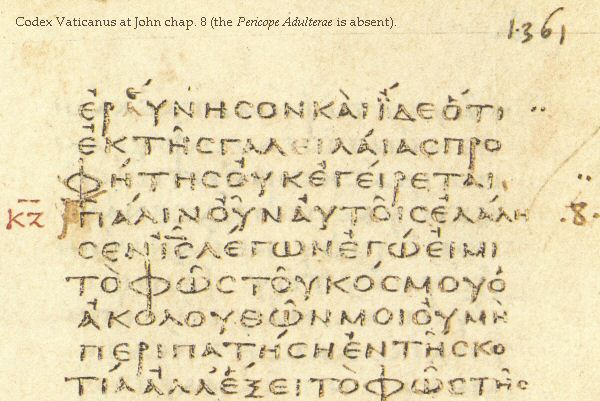
Below is an image of page NB (52) of Papyrus 66, a codex of John's Gospel from about AD 200. The begins in the middle of the word εραυνησον ("search") in John 7:52. On the second line the sentence ends with a punctuation mark and is immediately followed by Παλιν ουν αυτοις ελαλησεν ο Ις ("again Jesus spoke to them") in 8:12, omitting the Story of the Adulteress.
The manuscript has been annotated by a scribe who used diagonal strokes to indicate a word-order variant in the first and second lines, but the Story of the Adulteress is omitted without any notation.

The manuscript has been annotated by a scribe who used diagonal strokes to indicate a word-order variant in the first and second lines, but the Story of the Adulteress is omitted without any notation.
The New Commentary on the Whole Bible
"This story is not included in the best and earliest manuscripts [of John]. In fact, it is absent from all witnesses earlier than the 9th century, with the exception of a fifth century Greek-Latin manuscript. No Greek church father comments on the passage prior to the 12th century.Jamieson et al, "The New Commentary on the Whole Bible", Tyndale, Wheaton IL (1990), P. 247-248
The "Interpreter's One Volume Commentary on the Bible"
"7:53-8:11: This passage is omitted or set off in modern editions of the gospel since it does not appear in the oldest and best manuscripts and is apparently a later interpolation. In some manuscripts it occurs after Luke 21:38
The Five Gospels
"The story of the woman caught in the act of adultery...was a 'floating' or 'orphan' story. It is almost certainly not a part of the original text of John, but is a noteworthy tradition nonetheless...While the Fellows [of the Jesus Seminar] agreed that the words did not originate in their present form with Jesus, they nevertheless assigned the words and story to a special category of things they wish Jesus had said and done."
Did Jesus want to kill Balaam, the prophet ?
In the bible, we read in Numbers 22:
22. But God was very angry when he went, and the angel of the LORD stood in the road to oppose him. Balaam was riding on his donkey, and his two servants were with him.
23 When the donkey saw the angel of the LORD standing in the way with his drawn sword in his hand, the donkey turned off from the way and went into the field; but Balaam struck the donkey to turn her back into the way.…

Many Christ-worshippers believe that the angel is actually Jesus 'preincarnate'. This is a grave accusation against Jesus. For example, here, we read:
The angel of the Lord stood in the path. The angel of the Lord was a preincarnate appearance of the Lord Jesus Christ, who appeared in the form of an angel in front of Balaam's donkey.
Matthew 19:29: 100 wives for Christians in Heaven !
And every one that has forsaken houses, or brothers, or sisters, or father, or mother, or wife (ἤ γυναῖκα), or children, or lands, for my name's sake, shall receive a hundred times more, and shall inherit everlasting life.
Verse 29. - ....." Some manuscripts, followed by some modern editors, omit or wife, the omission being probably first made by some critical scribe, who deemed that a wife should never be left. The Lord enumerates the persons and objects upon which men's hearts are most commonly and firmly fixed. He begins and ends the list with material possessions - houses and lands, and between them introduces in gradation the most cherished members of the family circle. "Forsaking wife and children" may be understood as abstaining from marriage in order the better to serve God. For my Name's sake. In consequence of belief in Christ, rather than do despite to his grace, or in order to confess and follow him more completely........ An hundredfold. Some read "manifold," as in Luke 18:30. The spiritual relationship into which religion would introduce him largely compensates for the loss of earthly connections. He shall have brothers and sisters in the faith - hundreds who will show him the affection of father and mother, hundreds who will love him as well as wife and children. .......... The hope of future happiness is in itself sufficient to lighten and dissipate all earthly troubles, and to stimulate severest sacrifices."
This verse is a proof that the bible is altered according to scribes' own desires.
Jesus according to Quran

Sahih International
"O People of the Scripture, do not commit excess in your religion or say about Allah except the truth. The Messiah, Jesus, the son of Mary, was but a messenger of Allah and His word which He directed to Mary and a soul [created at a command] from Him. So believe in Allah and His messengers. And do not say, "Three"; desist - it is better for you. Indeed, Allah is but one God. Exalted is He above having a son. To Him belongs whatever is in the heavens and whatever is on the earth. And sufficient is Allah as Disposer of affairs."Abridged Ibn Katheer:
Prohibiting the People of the Book From Going to Extremes in Religion
Allah forbids the People of the Scriptures from going to extremes in religion, which is a common trait of theirs, especially among the Christians. The Christians exaggerated over `Isa until they elevated him above the grade that Allah gave him. They elevated him from the rank of prophethood to being a god, whom they worshipped just as they worshipped Allah. They exaggerated even more in the case of those who they claim were his followers, claiming that they were inspired, thus following every word they uttered whether true or false, be it guidance or misguidance, truth or lies. This is why Allah said,
Imam Ahmad recorded that Ibn `Abbas said that `Umar said that the Messenger of Allah said,
This is the wording of Al-Bukhari.
Imam Ahmad recorded that Anas bin Malik said that a man once said, "O Muhammad! You are our master and the son of our master, our most righteous person and the son of our most righteous person...'' The Messenger of Allah said,
Allah's statement,
This is why `Isa was a word and a Ruh (spirit) created by Allah, as he had no father to conceive him. Rather, he came to existence through the word that Allah uttered, `Be,' and he was, through the life that Allah sent with Jibril. Allah said,
And Allah said,
`Abdur-Razzaq narrated that Ma`mar said that Qatadah said that the Ayah,
Therefore, `Ruh from Allah', in the Ayah and the Hadith is similar to Allah's statement,
﴿اتَّخَذُواْ أَحْبَـرَهُمْ وَرُهْبَـنَهُمْ أَرْبَاباً مِّن دُونِ اللَّهِ﴾
(They took their rabbis and their monks to be their lords besides Allah.) Imam Ahmad recorded that Ibn `Abbas said that `Umar said that the Messenger of Allah said,
«لَا تُطْرُونِي كَمَا أَطْرَتِ النَّصَارَىِ عِيسَى ابْنَ مَرْيَمَ. فَإِنَّمَا أَنَا عَبْدٌفَقُولُوا: عَبْدُاللهِ وَرَسُولُه»
(Do not unduly praise me like the Christians exaggerated over `Isa, son of Maryam. Verily, I am only a servant, so say, `Allah's servant and His Messenger.')This is the wording of Al-Bukhari.
Imam Ahmad recorded that Anas bin Malik said that a man once said, "O Muhammad! You are our master and the son of our master, our most righteous person and the son of our most righteous person...'' The Messenger of Allah said,
«يَا أَيُّهَا النَّاسُ عَلَيْكُمْ بِقَوْلِكُمْ، وَلَا يَسْتَهْوِيَنَّكُمُ الشَّيْطَانُ،أَنَا مُحَمَّدُ بْنُ عَبْدِاللهِ، عَبْدُاللهِ وَرَسُولُهُ، وَاللهِ مَا أُحِبُّ أَنْ تَرْفَعُونِي فَوْقَ مَنْزِلَتِي الَّتِي أَنْزَلَنِي اللهُ عَزَّ وَجَل»
(O people! Say what you have to say, but do not allow Shaytan to trick you. I am Muhammad bin `Abdullah, Allah's servant and Messenger. By Allah! I do not like that you elevate me above the rank that Allah has granted me.)Allah's statement,
﴿وَلاَ تَقُولُواْ عَلَى اللَّهِ إِلاَّ الْحَقَّ﴾
(nor say of Allah except the truth.) means, do not lie and claim that Allah has a wife or a son, Allah is far holier than what they attribute to Him. Allah is glorified, praised, and honored in His might, grandure and greatness, and there is no deity worthy of worship nor Lord but Him. Allah said;﴿إِنَّمَا الْمَسِيحُ عِيسَى ابْنُ مَرْيَمَ رَسُولُ اللَّهِ وَكَلِمَتُهُ أَلْقَـهَا إِلَى مَرْيَمَ وَرُوحٌ مِّنْهُ﴾
(Al-Masih `Isa, son of Maryam, was (no more than) a Messenger of Allah and His Word, which He bestowed on Maryam and a spirit from ﴿created by﴾ Him;) `Isa is only one of Allah's servants and one of His creatures. Allah said to him, `Be', and he was, and He sent him as a Messenger. `Isa was a word from Allah that He bestowed on Maryam, meaning He created him with the word `Be' that He sent with Jibril to Maryam. Jibril blew the life of `Isa into Maryam by Allah's leave, and `Isa came to existence as a result. This incident was in place of the normal conception between man and woman that results in children.This is why `Isa was a word and a Ruh (spirit) created by Allah, as he had no father to conceive him. Rather, he came to existence through the word that Allah uttered, `Be,' and he was, through the life that Allah sent with Jibril. Allah said,
﴿مَّا الْمَسِيحُ ابْنُ مَرْيَمَ إِلاَّ رَسُولٌ قَدْ خَلَتْ مِن قَبْلِهِ الرُّسُلُ وَأُمُّهُ صِدِّيقَةٌ كَانَا يَأْكُلاَنِ الطَّعَامَ﴾
(Al-Masih ﴿`Isa﴾, son of Maryam, was no more than a Messenger; many were the Messengers that passed away before him. His mother ﴿Maryam﴾ was a Siddiqah. They both ate food.)And Allah said,
﴿إِنَّ مَثَلَ عِيسَى عِندَ اللَّهِ كَمَثَلِ ءَادَمَ خَلَقَهُ مِن تُرَابٍ ثُمَّ قَالَ لَهُ كُن فَيَكُونُ ﴾
(Verily, the likeness of `Isa before Allah is the likeness of Adam. He created him from dust, then (He) said to him: "Be! ـ and he was.)﴿وَالَّتِى أَحْصَنَتْ فَرْجَهَا فَنَفَخْنَا فِيهَا مِن رُّوحِنَا وَجَعَلْنَـهَا وَابْنَهَآ ءَايَةً لِّلْعَـلَمِينَ ﴾
(And she who guarded her chastity, We breathed into her (garment) and We made her and her son ﴿`Isa﴾ a sign for all that exits.) (21:91)﴿وَمَرْيَمَ ابْنَةَ عِمْرَانَ الَّتِى أَحْصَنَتْ فَرْجَهَا﴾
(And Maryam, the daughter of `Imran who guarded her chastity,) and Allah said concerning the Messiah,﴿إِنْ هُوَ إِلاَّ عَبْدٌ أَنْعَمْنَا عَلَيْهِ﴾
(He ﴿`Isa﴾ was not more than a servant. We granted Our favor to him.)`Abdur-Razzaq narrated that Ma`mar said that Qatadah said that the Ayah,
﴿وَكَلِمَتُهُ أَلْقَـهَا إِلَى مَرْيَمَ وَرُوحٌ مِّنْهُ﴾
(And His Word, which He bestowed on Maryam and a spirit from ﴿created by﴾ Him;) means, He said,﴿كُنَّ﴾
(Be) and he was. Ibn Abi Hatim recorded that Ahmad bin Sinan Al-Wasiti said that he heard Shadh bin Yahya saying about Allah's statement,﴿وَكَلِمَتُهُ أَلْقَـهَا إِلَى مَرْيَمَ وَرُوحٌ مِّنْهُ﴾
(and His Word, which He bestowed on Maryam and a spirit from ﴿created by﴾ Him;) "`Isa was not the word. Rather, `Isa came to existence because of the word.'' Al-Bukhari recorded that `Ubadah bin As-Samit said that the Prophet said,«مَنْ شَهِدَ أَنْ لَا إِلهَ إِلَّا اللهُ، وَحْدَهُ لَا شَرِيكَ لَهُ، وَأَنَّ مُحَمَّدًا عَبْدُهُ وَرَسُولُهُ، وَأَنَّ عِيسَى عَبْدُاللهِ وَرَسُولُهُ وَكَلِمَتُهُ أَلْقَاهَا إِلى مَرْيَمَ وَرُوحٌ مِنْهُ، وَأَنَّ الْجَنَّةَ حَقٌّ، وَالنَّارَ حَقٌّ، أَدْخَلَهُ اللهُ الْجَنَّةَ عَلَى مَا كَانَ مِنَ الْعَمَل»
(If anyone testifies that none has the right to be worshipped but Allah Alone Who has no partners, and that Muhammad is His servant and Messenger, and that `Isa is Allah's servant and Messenger and His Word which He bestowed on Maryam and a spirit created by Him, and that Paradise is true and Hell is true, then Allah will admit him into Paradise with the deeds which he performed.) In another narration, the Prophet said,«مِنْ أَبْوَابِ الْجَنَّةِ الثَّمَانِيَّةِ يَدْخُلُ مِنْ أَيِّهَا شَاء»
(...through any of the eight doors of Paradise he wishes.) Muslim also recorded it. Therefore, `Ruh from Allah', in the Ayah and the Hadith is similar to Allah's statement,
﴿وَسَخَّرَ لَكُمْ مَّا فِى السَّمَـوَتِ وَمَا فِى الاٌّرْضِ جَمِيعاً مِّنْهُ﴾
(And has subjected to you all that is in the heavens and all that is in the earth; it is all from Him.) meaning, from His creation. `from Him' does not mean that it is a part of Him, as the Christians claim, may Allah's continued curses be upon them. Saying that something is from Allah, such as the spirit of Allah, the she-camel of Allah or the House of Allah, is meant to honor such items. Allah said,﴿هَـذِهِ نَاقَةُ اللَّهِ﴾
(This is the she-camel of Allah...) and,﴿وَطَهِّرْ بَيْتِىَ لِلطَّآئِفِينَ﴾
(and sanctify My House for those who circumambulate it.) An authentic Hadith states,«فَأَدْخُلُ عَلَى رَبِّي فِي دَارِه»
(I will enter on my Lord in His Home) All these examples are meant to honor such items when they are attributed to Allah in this manner. Allah said,﴿فَـَامِنُواْ بِاللَّهِ وَرَسُولِهِ﴾
(so believe in Allah and His Messengers.) believe that Allah is One and Alone and that He does not have a son or wife. Know and be certain that `Isa is the servant and Messenger of Allah. Allah said after that,﴿وَلاَ تَقُولُواْ ثَلَـثَةٌ﴾
(Say not: "Three!") do not elevate `Isa and his mother to be gods with Allah. Allah is far holier than what they attribute to Him. In Surat Al-Ma'idah (chapter 5), Allah said,﴿لَّقَدْ كَفَرَ الَّذِينَ قَالُواْ إِنَّ اللَّهَ ثَـلِثُ ثَلَـثَةٍ وَمَا مِنْ إِلَـهٍ إِلاَّ إِلَـهٌ وَحِدٌ﴾
(Surely, disbelievers are those who said: "Allah is the third of the three.'' But there is none who has the right to be worshipped but One God.) Allah said by the end of the same Surah,﴿وَإِذْ قَالَ اللَّهُ يعِيسَى ابْنَ مَرْيَمَ أَءَنتَ قُلتَ لِلنَّاسِ اتَّخِذُونِى﴾
(And (remember) when Allah will say (on the Day of Resurrection): "O `Isa, son of Maryam! Did you say unto men: `Worship me''') and in its beginning,﴿لَّقَدْ كَفَرَ الَّذِينَ قَآلُواْ إِنَّ اللَّهَ هُوَ الْمَسِيحُ ابْنُ مَرْيَمَ﴾
(Surely, in disbelief are they who say that Allah is the Messiah, son of Maryam.) The Christians, may Allah curse them, have no limit to their disbelief because of their ignorance, so their deviant statements and their misguidance grows. Some of them believe that `Isa is Allah, some believe that he is one in a trinity and some believe that he is the son of Allah. Their beliefs and creeds are numerous and contradict each other, prompting some people to say that if ten Christians meet, they would end up with eleven sects! Sa`id bin Batriq, the Patriarch of Alexandria and a famous Christian scholar, mentioned in the year four hundred after the Hijrah, that a Christian Council convened during the reign of Constantine, who built the city that bears his name. In this Council, the Christians came up with what they called the Great Trust, which in reality is the Great Treachery. There were more than two thousand patriarchs in this Council, and they were in such disarray that they divided into many sects, where some sects had twenty, fifty or a hundred members, etc.! When the king saw that there were more than three hundred Patriarchs who had the same idea, he agreed with them and adopted their creed. Constantine who was a deviant philosopher -- gave his support to this sect for which, as an honor, churches were built and doctrines were taught to young children, who were baptized on this creed, and books were written about it. Meanwhile, the king oppressed all other sects. Another Council produced the sect known as the Jacobites, while the Nestorians were formed in a third Council. These three sects agreed that `Isa was divine, but disputed regarding the manner in which `Isa's divinity was related to his humanity; were they in unity or did Allah incarnate in `Isa! All three of these sects accuse each other of heresy and, we believe that all three of them are disbelievers. Allah said,
﴿انتَهُواْ خَيْراً لَّكُمْ﴾
(Cease! (it is) better for you.) meaning, it will be better for you,﴿إِنَّمَا اللَّهُ إِلَـهٌ وَحِدٌ سُبْحَـنَهُ أَن يَكُونَ لَهُ وَلَدٌ﴾
(For Allah is (the only) One God, hallowed be He above having a son.) and He is holier than such claim,﴿وَللَّهِ مَا فِى السَّمَـوَتِ وَمَا فِى الاٌّرْضِ وَكَفَى بِاللَّهِ وَكِيلاً ﴾
(To Him belongs all that is in the heavens and all that is in the earth. And Allah is All-Sufficient as a Disposer of affairs,) for all are creatures, property and servants under His control and disposal, and He is the Disposer of the affairs. Therefore, how can He have a wife or a son among them,﴿بَدِيعُ السَّمَـوَتِ وَالاٌّرْضِ أَنَّى يَكُونُ لَهُ وَلَدٌ﴾
(He is the originator of the heavens and the earth. How can He have children.) http://www.islamicstudies.info/ibnkathir/ibnkathir.php?sid=4&tid=13003
Commentary
The word:  : Kalimatuh used in this verse tells us that Sayyidna 'Isa (A.S) is the 'word' of Allah. Commentators have given different meanings of this expression:
1. Imam al-Ghazzali has said that two factors operate in the birth of a child: One is the sperm, the other is the saying of the word  or 'be' by Almighty Allah after which the child comes to exist. Since the first factor is out of question in the case of Sayyidna 'Isa (A.S), therefore, it was by attribution to the second factor that he was called
  (the word of Allah). It means that he came into existence solely through the word: (be) without the mediacy of material means. In this case, the statement which follows immediately, that is,
  would mean that Almighty Allah delivered this word to Maryam (A.S) as a result of which the birth of Sayyidna 'Isa (A.S) came to be.
2. Some have said that the expression: (the word of Allah) has been used in the sense of:  (the glad tiding of Allah) and it refers to Sayyidna 'Isa (A.S). It will be recalled that the glad tiding of the coming of Sayyidna 'Isa (A.S) given to Maryam (A.S) by Almighty Allah through the angels carries the expression: Kalimah or word:
  (When the angels said, "O Maryam, Allah gives you the good news of a word ... 3:45).
3. Some have said that kalimah (word) has been used here in the sense of 'ayah or sign, as it has appeared elsewhere in the same sense:  'She (Maryam) testified to the word of her Lord as true.' (66:12)
Let us now consider the statement:  (... and a spirit from Him.) in this verse. Worth attention here are two aspects of our probe. Firstly, why has Sayyidna 'Isa (A.S) been referred to as ruh or spirit? Secondly, since by saying 'from Him' the spirit has been attributed to Almighty Allah what, then, would be the sense of such an attribution?
In this connection, several exegetical stances of commentators have been reported. Their gist is being given below:
1. Some of them explain it on the basis of lexical usage. They say that, according to the rule of 'urf or recognized customary practice, the word 'ruh' or 'spirit' is used in the sense of 'essence' to enhance the effect of pristine purity in something. Since the birth of Sayyidna Isa (A.S) was totally unrelated to the mediation of any father and he was the outcome of nothing but the will of Allah, in His supreme majesty, and a result of the word: (Kun: be), therefore, he Was blessed with the most perfect degree of purity. This is the reason why he was called 'a spirit' or 'essence' as admitted by recognized practice. As for the attribution to Allah, it is there to hold him in esteem. This is like attributing Masajid (mosques) to Allah in order to enhance the respect in which they are held. Hence, the expression: Masajidullah or the Mosques of Allah. Or, the Holy Ka'bah, by attributing it to Allah, is called: Baytullah or the House of Allah. Or, by attributing someone religiously observing and worshipfully obedient to Allah, he is called: 'Abd Allah' or the servant or slave of Allah. Thus, it is in accord with this formulation that the Holy Prophet  has been referred to in Surah Bani Isra'il in the wordings:
  (carried His servant) (17:1) where the attribution to Allah reflects honour given to him.
2. Some commentators have said that the purpose behind the coming of Sayyidna 'Isa (A.S) was that he should infuse spiritual life into the dead hearts of people and make them alive once again (familiar as born-again Christians in the West). Since he was the cause of spiritual life very much like the spirit is the cause of physical life, therefore, it was in this light that he was called a spirit. In fact, this word has been used for the Holy Qur'an as well:  (and thus We have revealed to you a spirit of Our Command - 42:52) because the Holy Qur'an too blesses people with spiritual life.
3. Some others have said that ruh (spirit) is also used in the sense of secret. Since Sayyidna 'Isa (A.S) was, because of his unusual birth, a sign and secret of Allah, therefore, he was called: Ruhullah (the spirit of Allah).
4. Some say that the adjunct is understood here since the statement was to be read as:  (the possessor of a spirit from Him). However, since all rational beings are equal as the possessors of a spirit, the distinction of Sayyidna Isa (A.S) was made manifest when Almighty Allah turned his attribution towards Himself.
5. According to yet another exegetical view, the word: Ruh has been used in the sense of nafkh or the blowing of breath. Sayyidna Jibra'il (A.S) had, as commanded by Allah, blown his breath on the collar of Sayyidah Maryam (A.S) and that became the conception. Since only a blow of breath had caused the birth of Savyidna 'Isa (A.S) as a miracle, therefore, he was called: Ruhullah or the spirit of Allah. Another verse of the Holy Qur'an:  (then, We blew Our spirit in her - 21:91) points out in this direction.
In addition to these, several other probabilities have also been suggested. However, none of these come to mean that Sayyidna 'Isa (A.S) is a part of Allah or a divine person on the basis of which it could be suggested that this very spirit we are talking about has manifested itself in the human form, of Sayyidna 'Isa (A.S).
A Telling Repartee
'Allamah Al-Alusi, the author of the famous Tafsir Ruh al-Ma'ani has reported an episode from the court of Caliph Harun al-Rashid where a Christian physician entered into a debate against the scholar 'All ibn al-Husayn al-Waqidi challenging him that his Book (the Qur'an) has a particular word which indicates that Sayyidna 'Isa (A.S) is a part of Allah. And as a proof, he read out the verse (171) which carries the words:  (a spirit from Him). 'Allamah al-Waqidi came up with a rejoinder and recited another verse (45:13) of the Qur'an:
  (The meaning of the verse is that everything that there is in the heavens and the earth is from the same Allah where the word - minhu: from Him - serves to attribute everything to Allah) and said:
  (ruhim-minhu: a spirit from Him) means, as you think, that Sayyidna 'Isa (A.S) is a part of Allah, then, the verse I have just recited would mean that every thing in the heavens and the earth is also a part of Allah?' Thus, silenced, the Christian physician chose to become a Muslim.
The Qur'an and the Doctrine of Trinity
Reflected in the statement of the Qur'an:  (And do not say "Three") is the state of the major sects among Christians in which they were divided at the time of the revelation of the.Qur'an. The doctrine of Trinity they adhered to was base on three separate principles. One sect maintained that Masih is God and it is God Himself who has appeared in the world in the form of Masih. The second sect believed that Masih is the son of God while the third sect claimed unity in trinity - the father, the son and Mary. Even this group was split in two. The second group said that the Holy Spirit (Ruhul-Quds) and not Sayyidah Maryam (Mary) was the third person (hypostasis). So, these people acknowledged Sayyidna Masih (A.S) as the third of the three. Therefore, all the three sects have been addressed, separately and jointly in the Holy Qur'an whereby the Christians have been clearly told that there is just one truth and that truth is that Masih (A.S) is a human being born to Maryam (A.S), and a true Messenger of God. Whatever is said beyond that is all false and ineffectual - whether it be loaded with the excess of under-estimation, as believed by the Jews, viz., God forbid, he was an imposter and fabricator: or, be a case of the excess of over-estimation as believed by the Christians, viz., God forbid, he is God or the son of God or the third of the three.
In many of its verses, the Holy Qur'an has, on the one hand, pointed out to the strayings of the Christians and Jews while, on the other, it has focused brightly on the exalted station of Sayyidna 'Isa (A.S) in the sight of Almighty Allah so that the true path of moderation could emerge clearly from out of the mazes of excess and deficiency.
Those interested in detailed information about various aspects of Christian beliefs vis-a-vis the veracity of Islam may wish to study the world-famous book, Izharul-Haqq by Maulana Rahmatullah Kiranawi. This original work in Arabic has been translated and published by Darul-Uloom, Karachi, Pakistan in three volumes with detailed annotations. [An English translation of this work has been recently completed by Maulana Muhammd Wali Raazi, son of Hadrat Mufti Muhammad Shafi  and is presently under the process of publication under the auspices of the translator himself.]
Towards the end of the verse, it was declared:  (To him belongs what is in the heavens and what is in the earth. And Allah is enough to trust in.). The drive of the meaning is: When everything has been created by Him, when everything falls under the domain of His mastery and when everyone is a servant ofAllah, who and how could anyone become His partner or associate or son? The fact is that Almighty Allah is the dispenser of all our needs and the sole caretaker of everyone's wants - He is universally and perennially sufficient, all by Himself. He needs nobody. How, then, could He need to have a partner or son?
To sum up, we can say that no created being has the ability or qualification to become His partner, nor does His most sacred Being have the room or need for it. This much is enough to tell us that suggesting a partner to God or ascribing a son to Him can be accomplished by none but the one who is deprived of faith and reason both.
Excess in Faith
Let us now go back to the opening statement of the verse:  . In this verse, the People of the Book have been asked not to indulge in excess in matters relating to their Faith. Lexically, the Qur'anic word:
  : al-Ghuluww means to cross the limits or transgress. In Ahkam al-Qur'an, Imam al-Jassas says:

Excess in Faith is crossing the limit set therein.
The People of the Book, that is, the Jews and the Christians were both made addressees of this injunction because excess in Faith is the common factor between them. Both groups have fallen victims to nothing but excess in matters of Faith. The Christians committed excess in believing and honouring Sayyidna 'Isa (A.S) when they went on to the extreme of taking him to be God or son of God or the third God. As for Jews, they committed excess in disbelieving and rejecting him - not simply that they did not accept him even as a prophet, they were audacious enough to, God forbid, impute a false accusation to his revered mother, Sayyidah Maryam (A.S) and to cast a slur against her parentage.
Since the disasterous deviation of Jews and Christians in matters of Faith was a common scene of the time, the Holy Prophet especially instructed his community to be very careful about it. According to a report from Sayyidna 'Umar  appearing in the Musnad of Ahmad, the Holy Prophet said:

Do not exaggerate in my praise as was done by Christians in the case of 'Isa son of Maryam (A.S). Beware, I am only a servant. So, call me a servant of Allah and His messenger. (This narration has also been reported by al-Bukhari and Ibn al-Madini rating it as sound and authentically reported)
In brief, the sense of what he said is: I am one with everyone in being a servant of Allah and a human being. The highest rank I have is that I am a Messenger of Allah. Raising it higher to the limit that you go about taking me as partner in the attributes of Almighty Allah is excess and I do not want you to fall into this excess like the Christians. This excess in Faith practiced by the Jews and Christians did not remain limited to prophets only. Once used to it, they extended this attitude of theirs to the apostles, followers and deputies of the prophets. They had already assigned Godhood to their prophet, now they invested the followers of the prophet with immunity from sin. While doing so, they did not even take the trouble of investigating and making sure if such followers were genuine followers of the prophet and who correctly and firmly adhered to his teachings, or they were no more than hereditary religious scholars and guides. This resulted in the emergence of a leadership which was astray in itself and could do nothing but keep adding to the strayings of others. So, they ruined their Faith by practicing it erroneously from within. The Holy Qur'an has described this very condition of these people in the verse:  (that is, these people took their religious leaders as objects of worship, other than Allah). It means that they had already been excessive in making their prophet a God, then, they started worshipping later-day religious leaders in the name of following the prophet!
The lesson to be learnt is that excess in Faith is a dangerous attitude which has destroyed the Faiths of earlier religious communities all in the fair name of Faith. So serious were the implications that our noble master devised perfect defences to keep his community safe against this terrible epidemic.
It appears in Hadith that the Holy Prophet asked Sayyidna'Abdullah ibn 'Abbas on the occasion of Hajj that he should go and collect pebbles which he could use to throw at the Jamarat. He returned with average-sized pebbles and presented them to the Holy Prophet who liked them very much and said twice:  (like these, like these) which means that one should do his or her ramy at Jamarat using average-sized pebbles litfe these. Then, he said:

It is your duty to avoid excess in Faith for communities before you were destroyed because of being excessive in their Faith.
The Ideal Solution
The Shari'ah of Islam has wisely shielded Muslims from falling into the trap of excess. The middle course in between the two extremes it has suggested is: Learn the Book of Allah (Kitabullah) from the Men of Allah (Rijalullah) and recognize the Men of Allah from the Book of Allah. In other words, one should first recognize those who are engaged in learning and communicating the true knowledge of the Qur'an and Sunnah through the all too well-known teachings of these twin sources of Islamic Faith. Once this is settled, no intricate problem relating to Qur'an and Sunnah will ever bother you - if you give precedence to their explanation above your own opinion, and follow them.
Why Muhammad Didn't Die for Muslims' Sins?
First, Islam, unlike Christianity, does not teach a concept of “original sin”. Adam’s sin was his and his alone; and, according to the Qur’an (for the Qur’anic narration of the story of Adam and Eve, see: the Qur’an: 2: 30-39; 7; 19; 17: 61; 18: 50; 20: 116-17, etc.), God forgave both Adam and Eve when they turned to God in repentance; accordingly they were once again restored to divine mercy. Hence there is no concept of Adam passing on to his progeny an original sin, and therefore no need for stipulating a redeemer for such sins.
Second, as there is no original sin, every one is born into a state of fitrah, a state of natural innocence; sin is acquired later by our own conscious and willful actions. The Prophet (peace and blessings be upon him) said, “Every child is born into a state of fitrah or natural state of innocence.”
Third, Islam teaches that God is All-Compassionate and All-Merciful; He is not bound by the rule of a blood sacrifice in order to forgive His servants. To assume that God can forgive only by accepting a blood sacrifice and therefore to state that Jesus or Muhammad died for our sins is not acceptable in Islam. Allah says: “O My servants who have wronged against their souls! Do not despair of Allah’s mercy! For Allah forgives all sins; for He is indeed Forgiving, Compassionate. Turn to your Lord repentant, and submit to Him before the torment overtakes you when you shall not be helped.” (Az-Zumar: 53-54)
Fourth, Islam teaches that every individual is responsible for his/her own salvation. Not Abraham, or Moses, or Jesus, or Muhammad can save us; they are only capable of saving themselves through God’s grace. In the words of the Qur’an: “Whoever commits a sin commits it only against himself. Allah is Knowing, Wise.” (An-Nisa': 111); “Allah does not charge a soul with more than it can bear. It shall be requited for whatever good and whatever it has done.” (Al-Baqarah: 286); “Each soul earns only on its own account, nor does any laden (soul) bear another’s load.” (Al-An`am: 164) “He who is rightly guided, it is for himself; and he who goes astray, it is to his own detriment. No soul can bear another’s burden.” (Al-Isra': 15)
Fifth, everyone, male or female, can directly approach God without any intermediary of a prophet, saint or priest. God is closer to us than our own jugular veins. Almighty Allah says in the Qur’an: “We created man, and We know the promptings of his soul, and We are nearer to him than his own jugular vein.” (Qaf: 16) “When My servants ask you about Me, tell them I am nigh, ready to answer the prayer of the suppliant when he/she prays to Me; therefore let them respond to Me and believe in Me, that they may be rightly guided.” (Al-Baqarah: 186)
So the entire concept of someone dying for our sins is inimical to the Islamic world-view or understanding of the natures of man and God. Islam beckons us all to respond to God’s message and receive His grace and salvation through faith, good works and leading a responsible moral and ethical life."
Peace be upon you all.
https://www.youtube.com/watch?v=jB7EZ5fgr4I
Second, as there is no original sin, every one is born into a state of fitrah, a state of natural innocence; sin is acquired later by our own conscious and willful actions. The Prophet (peace and blessings be upon him) said, “Every child is born into a state of fitrah or natural state of innocence.”
Third, Islam teaches that God is All-Compassionate and All-Merciful; He is not bound by the rule of a blood sacrifice in order to forgive His servants. To assume that God can forgive only by accepting a blood sacrifice and therefore to state that Jesus or Muhammad died for our sins is not acceptable in Islam. Allah says: “O My servants who have wronged against their souls! Do not despair of Allah’s mercy! For Allah forgives all sins; for He is indeed Forgiving, Compassionate. Turn to your Lord repentant, and submit to Him before the torment overtakes you when you shall not be helped.” (Az-Zumar: 53-54)
Fourth, Islam teaches that every individual is responsible for his/her own salvation. Not Abraham, or Moses, or Jesus, or Muhammad can save us; they are only capable of saving themselves through God’s grace. In the words of the Qur’an: “Whoever commits a sin commits it only against himself. Allah is Knowing, Wise.” (An-Nisa': 111); “Allah does not charge a soul with more than it can bear. It shall be requited for whatever good and whatever it has done.” (Al-Baqarah: 286); “Each soul earns only on its own account, nor does any laden (soul) bear another’s load.” (Al-An`am: 164) “He who is rightly guided, it is for himself; and he who goes astray, it is to his own detriment. No soul can bear another’s burden.” (Al-Isra': 15)
Fifth, everyone, male or female, can directly approach God without any intermediary of a prophet, saint or priest. God is closer to us than our own jugular veins. Almighty Allah says in the Qur’an: “We created man, and We know the promptings of his soul, and We are nearer to him than his own jugular vein.” (Qaf: 16) “When My servants ask you about Me, tell them I am nigh, ready to answer the prayer of the suppliant when he/she prays to Me; therefore let them respond to Me and believe in Me, that they may be rightly guided.” (Al-Baqarah: 186)
So the entire concept of someone dying for our sins is inimical to the Islamic world-view or understanding of the natures of man and God. Islam beckons us all to respond to God’s message and receive His grace and salvation through faith, good works and leading a responsible moral and ethical life."
Peace be upon you all.
https://www.youtube.com/watch?v=jB7EZ5fgr4I
Was Jesus God, a son of god , a man, a servant,or a prophet ?
Was Jesus God, a son of god , a man, a servant,or a prophet ?
1) Was Jesus a servant ?
Yes, the Bible says that :
1 ) "Behold my servant, whom I have chosen." (Matthew 12:18)
2) "The God of Abraham, and of Isaac,.... hath glorified his servant Jesus." (Acts 3:13(RSV)
3) "For of a truth against thy holy servant Jesus, whom thou hast anointed...." ( Acts 4:27(RSV)
The exact same word "pias" is attributed to Jacob (Israel) in Luke 1:54 and translated as "servant "(( Can any father call his son "servant " . Can a servant equal his master ? .Who is supreme in rank ? Who orders who and who obeys who ? ))
1 ) "Behold my servant, whom I have chosen." (Matthew 12:18)
2) "The God of Abraham, and of Isaac,.... hath glorified his servant Jesus." (Acts 3:13(RSV)
3) "For of a truth against thy holy servant Jesus, whom thou hast anointed...." ( Acts 4:27(RSV)
The exact same word "pias" is attributed to Jacob (Israel) in Luke 1:54 and translated as "servant "(( Can any father call his son "servant " . Can a servant equal his master ? .Who is supreme in rank ? Who orders who and who obeys who ? ))
2) Was Jesus a man or a son of man?
Yes, the Bible says that :
1)ye men of Israel , hear these word; Jesus of Nazareth, was a MAN approved of God among you by miracles, wonders, and signs.(Acts 2:22)
2) the son of MAN came eating and drinking. (Matthew 11:19)
3) this MAN is really the prophet. (John 7:40)
3) Now ye seek to kill me, a MAN that hath told you the truth, which I have heard of God .(John 8:40 KJV)
4) “…so will the son of man be…” Matthew 12:40
5) “For the son of man is going to come…” Matthew 16:27
6) “…until they see the son of man coming in His kingdom.” Matthew 28
7) “But so that you may know that the Son of Man has authority…” Mark 2:10
“…because He is the son of man.” John 5:27
9) “Jesus the Nazarene, a man attested to you by God with miracles and wonders and signs which God performed through Him in your midst, just as you yourselves know.” (Acts 2:22)
10) “He will judge the world in righteousness through a man whom He has appointed” Acts 17:31
(( Jesus testified himself that he is " a man" why didn`t he clearly and openly say: "Now you seek to kill me, God incarnate, who has told you the truth." Is it possible that he was hiding the truth? He denied any divinity to himself .Can a man be god ? The bible says strongly : “God is not a man...nor a son of man…” Numbers 23:19 . ))
1)ye men of Israel , hear these word; Jesus of Nazareth, was a MAN approved of God among you by miracles, wonders, and signs.(Acts 2:22)
2) the son of MAN came eating and drinking. (Matthew 11:19)
3) this MAN is really the prophet. (John 7:40)
3) Now ye seek to kill me, a MAN that hath told you the truth, which I have heard of God .(John 8:40 KJV)
4) “…so will the son of man be…” Matthew 12:40
5) “For the son of man is going to come…” Matthew 16:27
6) “…until they see the son of man coming in His kingdom.” Matthew 28
7) “But so that you may know that the Son of Man has authority…” Mark 2:10
“…because He is the son of man.” John 5:27
9) “Jesus the Nazarene, a man attested to you by God with miracles and wonders and signs which God performed through Him in your midst, just as you yourselves know.” (Acts 2:22)
10) “He will judge the world in righteousness through a man whom He has appointed” Acts 17:31
(( Jesus testified himself that he is " a man" why didn`t he clearly and openly say: "Now you seek to kill me, God incarnate, who has told you the truth." Is it possible that he was hiding the truth? He denied any divinity to himself .Can a man be god ? The bible says strongly : “God is not a man...nor a son of man…” Numbers 23:19 . ))
3) Was Jesus a prophet or a messenger ?
Yes, the Bible says that :
These are just some of the many Biblical verses which point out that Jesus was a prophet and a messenger of the one true God :
1) this is Jesus the prophet of Nazareth. (Matthew 21:11)
2) Jesus said, "A prophet is never accepted in his home town." (Luke 4:24)
3) I tell you the truth, no servant is greater than his master, nor is a messenger greater than
the one who sent him. (John 13:16)
4) Surely this is the prophet who is to come into the word. (John 24:19)
5) "'What things?' he asked. 'About Jesus of Nazareth,' they replied. 'He was a prophet, powerful in word and deed before God and all the people.'" (Luke 24:19)
These are just some of the many Biblical verses which point out that Jesus was a prophet and a messenger of the one true God :
1) this is Jesus the prophet of Nazareth. (Matthew 21:11)
2) Jesus said, "A prophet is never accepted in his home town." (Luke 4:24)
3) I tell you the truth, no servant is greater than his master, nor is a messenger greater than
the one who sent him. (John 13:16)
4) Surely this is the prophet who is to come into the word. (John 24:19)
5) "'What things?' he asked. 'About Jesus of Nazareth,' they replied. 'He was a prophet, powerful in word and deed before God and all the people.'" (Luke 24:19)
4) Was Jesus a god or a son of god ?
Jesus never said he is a god or a son of god Let us see what Jesus himself said :
1) "For I have not spoken of myself; but the Father which sent me, he gave me a commandment, what I should say, and what I should speak." (John 12:49)
2) I can of mine own self do nothing: as I hear, I judge: and my judgment is just; because I seek not mine own will, but the will of the Father which hath sent me.(John 5:30)
3) Hear, O Israel: The Lord our God is one Lord" ((and this was the message of all prophets sent by Allah from Adam to Muhammad (peace be upon them all ) "There is no God but God" and if Jesus (peace be upon him) was a god or a son of god he would declare that strongly ))
4) My father is greater than I (Jesus) (John 14:28)
5) My father, who gave them to me, is greater than all. (John 10:29)
6) What I teach is not my own teaching, but it comes from God,who sent me. (John 5:30) ((In these verses Jesus (peace be upon him) declares his complete submission and surrender to the will of our unique God and didn't impute any power or any strength to himself and that was the matter of all prophets before him ))
7) "And Jesus said unto him, Why callest thou me good? There is none good but one, that is, God." (Mark 10:18) ((Jesus refused to be called "good" although we humanbeings describe ourselves "good" and this was the top of humbleness of Juses. Jesus emphatically corrects any notion that he was God; he does not like to be called even good, as genuine goodness is a quality of God alone. If Jesus were God, his words do not make sense; because, it does not befit God to humble Himself before His creatures.Then we don't believe that he claimed or accepted to be god or a son of god ))
8) No one knows, however, when that day or hour will come neither the angels in heaven, nor the son; only the Father Knows. (mark 13:32) (( If he was god he should have known the time of that day but he said the truth and that does not belittle of his rank as one of the greatest prophets that God sent to the human beings . In fact a sincere seeker of the truth should accept what Jesus says about himself and not make Him God or the equal of God!))
9) *Anyone who says something against the son of man can be forgiven, but whoever says something against the Holy Spirit will not be forgiven-now or ever.(Matthew 12:32)
10) I ascend unto my Father, and your Father; and to my God, and your God. (John 20:17) (( Then The father is the father of Jesus and all people ))
11) Jesus said to him, "Away from me, Satan! For it is written: 'Worship the Lord your God, and him only.'" (Matthew 4:10)
12) "Well said, teacher," the man replied. "You are right in saying that God is one and there is no other but him." (Mark 12:32)
13) "The Lord our God is Lord alone! Therefore, you shall adore the Lord your God with all your heart, with all your soul, with all your mind, and with all your strength." (Deuteronomy 6:4-5, Mark 12:29-30)
1) "For I have not spoken of myself; but the Father which sent me, he gave me a commandment, what I should say, and what I should speak." (John 12:49)
2) I can of mine own self do nothing: as I hear, I judge: and my judgment is just; because I seek not mine own will, but the will of the Father which hath sent me.(John 5:30)
3) Hear, O Israel: The Lord our God is one Lord" ((and this was the message of all prophets sent by Allah from Adam to Muhammad (peace be upon them all ) "There is no God but God" and if Jesus (peace be upon him) was a god or a son of god he would declare that strongly ))
4) My father is greater than I (Jesus) (John 14:28)
5) My father, who gave them to me, is greater than all. (John 10:29)
6) What I teach is not my own teaching, but it comes from God,who sent me. (John 5:30) ((In these verses Jesus (peace be upon him) declares his complete submission and surrender to the will of our unique God and didn't impute any power or any strength to himself and that was the matter of all prophets before him ))
7) "And Jesus said unto him, Why callest thou me good? There is none good but one, that is, God." (Mark 10:18) ((Jesus refused to be called "good" although we humanbeings describe ourselves "good" and this was the top of humbleness of Juses. Jesus emphatically corrects any notion that he was God; he does not like to be called even good, as genuine goodness is a quality of God alone. If Jesus were God, his words do not make sense; because, it does not befit God to humble Himself before His creatures.Then we don't believe that he claimed or accepted to be god or a son of god ))
8) No one knows, however, when that day or hour will come neither the angels in heaven, nor the son; only the Father Knows. (mark 13:32) (( If he was god he should have known the time of that day but he said the truth and that does not belittle of his rank as one of the greatest prophets that God sent to the human beings . In fact a sincere seeker of the truth should accept what Jesus says about himself and not make Him God or the equal of God!))
9) *Anyone who says something against the son of man can be forgiven, but whoever says something against the Holy Spirit will not be forgiven-now or ever.(Matthew 12:32)
10) I ascend unto my Father, and your Father; and to my God, and your God. (John 20:17) (( Then The father is the father of Jesus and all people ))
11) Jesus said to him, "Away from me, Satan! For it is written: 'Worship the Lord your God, and him only.'" (Matthew 4:10)
12) "Well said, teacher," the man replied. "You are right in saying that God is one and there is no other but him." (Mark 12:32)
13) "The Lord our God is Lord alone! Therefore, you shall adore the Lord your God with all your heart, with all your soul, with all your mind, and with all your strength." (Deuteronomy 6:4-5, Mark 12:29-30)
5) Was Jesus the only one who was called the son of God in the Bible ?
No,the Bible doesn't say that :
1) Adam is the son of God. (Luke 3:38)
2) Israel is my first-born son.(Exodus 4:22)
3) The Lord has said unto me, thou art my son; this day have I begotten thee." (Psalms 2:7,KJM).
,4) David is another begotten Son
*Blessed are the peacemaker, for they will be called sons of God. (Matthew 5:9)
((Tracing this title : son of God" in the Bible, we can find many "sons of God" and that Jesus is not the only son.It can be concluded that the Bible uses this title" son of God" figuratively to mean Righteous, pious, selected, or God-conscious.))
1) Adam is the son of God. (Luke 3:38)
2) Israel is my first-born son.(Exodus 4:22)
3) The Lord has said unto me, thou art my son; this day have I begotten thee." (Psalms 2:7,KJM).
,4) David is another begotten Son
*Blessed are the peacemaker, for they will be called sons of God. (Matthew 5:9)
((Tracing this title : son of God" in the Bible, we can find many "sons of God" and that Jesus is not the only son.It can be concluded that the Bible uses this title" son of God" figuratively to mean Righteous, pious, selected, or God-conscious.))
6) Can God be a man ?
((Can God be a man,eat as man,feel hungry ,go to toilet ,is crucified,tortured and be seen and be heard ,cry on the cross and be spit on his face and doesn't have the power to destroy his enemies and pray to his god.What god is that ?))
1) “God is not a man...nor a son of man…” (Numbers 23:19)
2) “...For I am God, and not man...” (Hosea 11:9)
3) Matthew 26:39: "And he went a little farther, and fell on his face, and prayed, saying, O my Father, if it be possible, let this cup pass from me: nevertheless not as I will, but as thou wilt."
4) in John 5:32 Jesus told his followers that they have never seen GOD at anytime nor ever heard his voice?
5) "Ye have neither heard his voice at any time, nor seen his shape." (John 5:37)
6) "Eli, Eli, lama sabachtani (My God, my God, why hast thou forsaken me?)
1) “God is not a man...nor a son of man…” (Numbers 23:19)
2) “...For I am God, and not man...” (Hosea 11:9)
3) Matthew 26:39: "And he went a little farther, and fell on his face, and prayed, saying, O my Father, if it be possible, let this cup pass from me: nevertheless not as I will, but as thou wilt."
4) in John 5:32 Jesus told his followers that they have never seen GOD at anytime nor ever heard his voice?
5) "Ye have neither heard his voice at any time, nor seen his shape." (John 5:37)
6) "Eli, Eli, lama sabachtani (My God, my God, why hast thou forsaken me?)
(( Finally after discussing evidence from the Bible . In fact that God is one, NOT THREE, that
Jesus is not God or part of God, that he is not equal with God, and that He is not the son of God in the literal sense .The son of god is common in the Bible and it is not underage on Jesus only (peace be upon him )) Please be logical and be rational and don't say what Jesus (peace be upon him) didn't say about himself .He was a model in his faith and in his submission to the will of the only unique God (praise be to him ) . Saying Jesus is a god or a son of god is the biggest sin which God never forgive and Jesus himself prophesied that people would worship him uselessly and believe in doctrines made by men (Matthew 15:9). "But in vain they do worship me, teaching for doctrines the commandments of men." Jesus (peace be upon him) in this verse warns his followers from being worshippers to him .He ordered his people not to exaggerate in their love to him .
Thank you .
http://www.truthknights.com/viewtopic.php?f=4&t=394
100 biblical responses to those who claim that Jesus is God
1. Because Jesus Christ is represented by the sacred writers to be as distinct a being from God the Father as one man is distinct from another. “It is written in your law, that the testimony of two men is true. I am one who bear witness of myself, and the Father that sent me beareth witness of me,” John 8:17, 18.
2. Because he not only never said that himself was God, but, on the contrary, spoke of the Father, who sent him, as God, and as the only God. “This is life eternal, that they might know Thee, the only true God, and Jesus Christ whom thou hast sent,” John 17:3. This language our Saviour used in solemn prayer to “his Father and our Father.”
3. Because he is declared, in unnumbered instances, to be the Son of God. “And lo, a voice from heaven, saying, this is my beloved Son, in whom I am well pleased,” Matt 3:17. Can a son be coeval (the same age) and the same with his father?
4. Because he is styled the Christ, or the anointed of God. “God anointed Jesus of Nazareth with the Holy Ghost and with power,” Acts 10:38. Is he who anoints the same with him who is anointed?
5. Because he is represented as a Priest. “Consider the ….High-Priest of our profession, Christ Jesus,” Heb. 3:1. The office of a priest is to minister to God. Christ, then, as a priest, cannot be God.
6. Because Christ is Mediator between the “One God,” and “men.” “For there is one God, and one Mediator between God and men, the man Christ Jesus,” 1 Tim. 2:5.
7. Because, as the Saviour of men, he was sent by the Father. “And we have seen and do testify that the Father sent the Son to be the Saviour of the world. 1 John 4:14.
8. Because he is an Apostle appointed by God. “Consider the Apostle,…Christ Jesus, who was faithful to him that appointed him,” Heb. 3:1, 2.
9. Because Christ is represented as our intercessor with God. “It is Christ that died, yea, rather, that is risen again, who is even at the right hand of God, who also maketh intercession for us,” Rom. 8:34.
10. Because the head of Christ is God. “I would have you know, that the head of every man is Christ; and the head of every woman is the man; and the head of Christ is God,” 1 Cor. 11:3.
11. Because, in the same sense in which we are said to belong to Christ, Christ is said to belong to God. “And ye are Christ’s; and Christ is God’s,” 1 Cor. 3:23.
12. Because Christ says, “My father is greater than all,” John 10:29. Is not the father, then greater than the son?
13. Because he affirms, in another connection, and without the least qualification, “My Father is greater than I,” John 14:28
14. Because he virtually denies that he is God, when he exclaims, “Why callest thou me Good? There is none good but one, that is God,” Matt 19:17.
15. Because our Saviour, after having said, “I and my Father are one,” gives his disciples distinctly to understand that he did not mean one substance, equal in power and glory, but one only in affection and design, as clearly appears from the prayer he offers to his Father in their behalf, –“that they all may be one; as thou, Father, art in me, and I in thee, that they also may be one in us,” John 17:21
16. Because the Father is called the God of Christ as he is the God of Christians. “Jesus saith unto her, ….Go to my brethren, and say unto them, I ascend unto my Father and your Father; and to my God and your God,” John 20:17.
17. Because an Apostle says of God, in distinction from the “Lord Jesus Christ,” that He is the “only Potentate,” and that He “only hath immortality,” 1 Tim. 6:15, 16.
18. Because it is the express declaration of the same Apostle, that the Father is the one God, and there is none other. “Though there be that are called Gods, whether in heaven or in earth, (as there be gods many, and lords many,) yet to us there is but one God, the Father, of whom are all things,” 1 Cor. 8:5- 6.
19. Because the power which Christ possessed was, as him affirmed, given to him. “All power is given unto me,” Matt 28:18.
20. Because he positively denies himself to be the author of his miraculous works, but refers them to the Father, or the holy spirit of God. “The Father that dwelleth in me, he doeth the works,” John 14:10. “If I cast out devils by the spirit of God,” Matt. 12:28.
21. Because he distinctly states, that these works bear witness, not to his own power, but that the Father had sent him, John 5:36.
22. Because he expressly affirms that the works were done, not in his own, but in his Father’s name, John 10:25.
23. Because he asserts, that “him hath God the Father sealed,” i.e. to God the Father he was indebted for his credentials, John 6:27.
24. Because he declares that he is not the author of his own doctrine. “My doctrine is not mine, but his that sent me,” John 7:16, 17.
25. Because he represents himself as having been instructed by the Father. “As my Father hath taught me, I speak these things,” John 8:28.
26. Because he refers invariable to the Father as the origin of the authority by which he spoke and acted. “The Father hath given to the Son authority,” John 5:26, 27.
27. Because he acknowledges his dependence on his Heavenly Father for example and direction in all his doings. “The Son can do nothing of himself, but what he seeth the Father do,” John 5:19. “The Father loveth the Son, and showth him all things that himself doeth” John 5:20.
28. Because he says “I seek not mine own glory; but I honor my Father,” John 8:49, 50.
29. Because he declares, “If I honor myself, my honor is nothing: it is my Father that honoreth me,” John 8:54.
30. Because an Apostle declares, that Christ dwelt all fullness, because it so pleased the Father, Col. 1:19.
31. Because Christ is uniformly represented in the Scriptures, not as the primary, but the intermediate, cause of all things relating to our salvation. “One God, the Father, of whom are all things, and we in him; and one Lord Jesus Christ, by whom are all things, and we by him,” 1 Cor. 8:6.
32. Because he declares, “I am not come of myself” into the world, “for I proceeded forth and came from God,” John 8:42; 7:28. Jesus knowing… that he came from God, and went to God,” John 13:3.
33. Because he affirms that he had not the disposal of the highest places in his own kingdom. “To sit on my right and on my left is not mine to give, but it shall be given to them for whom it is prepared of my Father,” Matt. 20:23.
34. Because our Saviour, referring his disciples to a future time, when they would understand more accurately concerning him, expressly declares that then they would know him to be entirely dependent upon the Father. “When ye have lifted up the Son of man (i.e. crucified him), then shall ye know that I am he (i.e. the Messiah), and that I do nothing of myself, but as my Father hath taught me, I speak these things,” John 8:28.
35. Because our Saviour always professed to have no will of his own, but to be ever entirely guided and governed by the will of his Heavenly Father. “For I came down from heaven, not to do mine own will, but the will of him that sent me.” John 6:38.
36. Because he expressly denies that he is possessed of Divine attribute of independent existence. “As the living Father hath sent me, and I live by the Father,” John 6:57
37. Because he expressly disclaims the possession of the Divine attribute of underived existence. “As the Father hath life in himself, so hath he given to the Son to have life in himself,” John 5:26.
38. Because he positively denies that he is possessed of the Divine attribute of omnipotence. “I can of mine own self do nothing,” John 5:30.
39. Because he expressly disclaims the possession of the Divine attribute of omniscience. “But of that day and that hour knoweth no man, no, not the angels which are in heaven, neither the Son, but my Father only,” Matt.24:36, Mark 13:32.
40. Because Christ is said in the Scriptures to have been “tempted of the devil,” Matt. 4:1. But “God can not be tempted with evil.” James 1:13.
41. Because it is related of our Saviour, that “he continued all night in prayer to God,” Luke 6:12. Why should Christ thus pray, if he himself were God?
42. Because, in presence of a numerous company before the resurrection, he gave thanks to the Father for having heard him. “Father, I thank thee that thou has heard me, and I knew that thou hearest me always,” John 11:41, 42.
43. Because Jesus besought his Father to glorify him. “And now, O Father, glorify thou me with thyself with the glory which I had with thee before the world was,” John 17:5. The one who prayed to God to glorify him, cannot be God.
44. Because he implored that, if it were possible, the bitter cup might pass from him, adding, “Nevertheless, not as I will, but as thou wilt,” Matt 26:39.
45. Because he said, “My God, my God, why hast thou forsaken me?” Matt. 27:46 Can he who uttered this be the Supreme God?
46. Because he never paid his adoration to himself, the Son, nor to the Holy Ghost, as he should have done, had the Son and the Holy Ghost been God; but always to the Father.
47. Because he never instructed his disciples to worship himself or the Holy Ghost, but the Father, and the Father only. “When ye pray, say Our Father which art in heaven,” Luke 11:2. “In that day, ye shall ask me nothing. Whatsoever ye ask of the Father in my name,” John 16:23. “The hour cometh and now is, when the true worshippers shall worship the Father in spirit and in truth; for the Father seeketh such to worship him,” John 4:23.
48. Because it was not the practice of the Apostles to pay religious homage to Christ, but to God the Father through Christ. “I thank God through Jesus Christ,” Rom. 7:25. “To God only wise, be glory through Christ,” Rom 16:27. “I bow my knees unto the Father of our Lord Jesus Christ,” Eph. 3:14.
49. Because St. Peter, immediately after being filled with the Holy Spirit on the day of Pentecost, thus addressed the Jews: “Ye men of Israel, hear these words: Jesus of Nazareth, a man approved of God among you by miracles, and wonders, and signs which God did by him, in the midst of you, as ye yourselves also know him, being delivered by the determinate counsel and foreknowledge of God, ye have taken, and by wicked hands have crucified and slain; whom God hath raised up,” Acts 2:22-24.
50. Because St. Paul expressly states, that “all things are of God, who hath reconciled us to himself by Jesus Christ,” 2 Cor. 5:18.
51. Because the same Apostle gives “thanks to God, who giveth us the victory through our Lord Jesus Christ,” 1 Cor.15:57.
52. Because it is said that it is “to the glory of God the Father,” that “every tongue should confess that Jesus Christ is the Lord,” Phil. 2:11.
53. Because the Scriptures affirm that “Christ glorified not himself to be made a high priest, but He (glorified him) who said unto him, Thou art my Son, this day have I begotten thee,” Heb. 5:5.
54. Because it is expressly asserted that God gave to Christ the Revelation which was made to the author of the Apocalypse, Rev. 1:1.
55. Because an Apostle speaks of Christ, only as the image of God. “Who is the image of the image of the invisible God,” Col. 1:15. 2 Cor. 4: 4. It would be absurd to call anyone his own image.
56. Because Christ is stated to be “the first-born of every creature,” Col. 1:15.
57. Because he is said to be “the beginning of the creation of God,” Rev. 3: 14.
58. Because the Scriptures affirm, in so many words, that “Jesus was made a little lower than the angels,” Heb. 2:9. Can God become lower than his creatures?
59. Because Peter declares that “Christ received from God the Father honor and glory, when there came such a voice to him from the excellent glory, this is my beloved son,” 2 Peter 1:17.
60. Because it is represented as necessary that the Saviour of mankind should “be made like unto his brethren,” Heb. 2:17.
61. Because, in the Epistle to the Hebrews, Christ is compared with Moses in a manner that would be impious if he were the Supreme God. “For this man (Christ) was counted worthy of more glory than Moses, inasmuch,” Heb. 3:3.
62. Because he is represented as being the servant, the chosen, the beloved of God, and the recipient of God’s spirit. “Behold, my servant, whom I have chosen, in whom my soul is well pleased; I will put my spirit upon him,” Matt. 12:18.
63. Because he himself expressly declares that it was in consequence of his doing what pleased the Father, that the Father was with him and did not leave him alone. “He that sent me is with me; the Father hath not left me alone, for I do always those things that please him,” John 8:29.
64. Because he is said to have “increased in wisdom, and in favor with God and man,” Luke 2:52.
65. Because he speaks of himself as one who had received commands from the Father. “The Father, who sent me, he gave me a commandment,” John 12:49.
66. Because he is represented as obeying the Father, and as having been “obedient unto death,” Phil. 2:8. “Even as the Father said unto me, so I speak,” John 12:50. “I have kept my Father’s commandments,” John 15:10.
67. Because Christ “Learned obedience by the things he suffered,” and through sufferings was made perfect by God, Heb. 5:8.
68. Because he is spoken of in the Scriptures as the first born among many brethren. Rom. 8:29. Has God brethren?
69. Because Christ calls everyone who obeys God his brother. “Whosoever shall do the will of my Father in heaven, the same is my brother,” Matt. 12:50.
70. Because he offers to the faithful the like distinction and honor that himself has with the Father. “To him that overcometh will I grant to sit with me in my throne, even as I also overcame, and am sit down with my Father in his throne,” Rev. 3: 21.
71. Because God, in the later ages, hath spoken by his Son, and appointed him heir of all things, Heb. 1:2.
72. Because Christ is styled the first-begotten of the dead, Rev. 1:5.
73. Because it is declared that God raised him from the dead. “This Jesus hath God raised up, whereof we are all witnesses,” Acts 2: 32, Rom. 10:9, 10
74. Because God poured out upon the Apostles the Holy Spirit, through Jesus Christ, !@#$%^&*. 3:6.
75. Because the reason assigned for the Holy Spirit not having been received earlier, is that Jesus was not then glorified. “The Holy Ghost was not yet given because that Jesus was not yet glorified,” John 7:39.
76. Because it is affirmed that Christ was exalted by God to be a Prince and a Saviour, Acts 5:31.
77. Because God made that same Jesus, who was crucified, both Lord and Christ, Acts 2: 36.
78. Because God gave him a name which is above every name, Phil. 2:9.
79. Because Christ was ordained of God to be the judge of the quick and the dead, Acts 10:42.
80. Because God will judge the secrets of men by Jesus Christ, Rom. 2:16.
81. Because all judgment is committed to Christ by the Father, John 5:22.
82. Because our Saviour grounds the importance of his judgment solely upon the circumstances, that it is not exclusively his own judgment which he pronounces, but that of the Father who sent him. “If I judge, my judgment is true; for I am not alone, but I and the Father that sent me,” John 8:16.
83. Because it is said, that, when he was received up into heaven, he “sat on the right hand of God,” Mark 16:19.
84. Because St. Paul affirms, that Christ, even since his ascension, “liveth unto God,” and “liveth by the power of God,” Rom. 6:10. 2 Cor. 12:4.
85. Because it is affirmed of Christ, that “when all things shall be subdued under him then shall the Son also himself be subject unto him that put all things under him, that God may be all in all,” 1 Cor. 15:28.
86. Because the Apostle John asserts that “no man hath seen God at any time”; which is not true, if Christ were God, John 1:18.
87. Because, in the prophecies of the Old Testament that relate to Christ, he is spoken of as a being distinct from and inferior to God, Deut. 18:15, John 1:45.
88. Because the Jews never expected that any other than a being distinct from and inferior to God was to be their Messiah, and yet there is no evidence that our Saviour ever so much as hinted to them that this expectation was erroneous.
89. Because it does not appear from the Scriptures, that the Jews except in two instances, ever opposed our Saviour on the ground that he pretended to be God or equal with God; whereas, had it been his custom to assume such identity or equality, in his conversation with a people so strongly attached to the doctrine of the divine unity, he would have found himself involved in a perpetual controversy with them on this point, some traces of which must have appeared in the New Testament.
90. Because in these two instances, when charged, in the one case, with making himself God, and in the other, with making himself equal with God, he positively denies the charges. In reply to the charge of assuming to be equal with God, he says immediately, “The Son can do nothing of himself, but what he seeth the Father do”; and directly after, “I can of mine own self do nothing,” John 5:19, 30. In answer to the charge of making himself God, he appeals to the Jews in substance thus: Your own Scriptures call Moses a god, and your magistrates gods; I am surely not inferior to them, yet I did not call myself God, but only the Son of God, John 10:34-36.
91. Because, had his immediate disciples believe him to be the Almighty, would they have been so familiar with him, have argued with him, betrayed him, denied him, fled from him, and left him to be dragged to the cross?
92. Because the Apostles, after they had been filled with the Holy Ghost on the day of Pentecost, did not preach that Christ was God; but preached what was altogether inconsistent with such a doctrine, Acts 2:22; 13:23; 17:3, 31; 22:8.
93. Because there is no evidence to prove that the first converts to Christianity ever incurred the imputation of idolatry from the Jews, as they must have done had they believed and taught that the Son, as well as the Father, is Jehovah; while it is notorious that this imputation has been among the most common of the Jewish reproaches against Christians, since the Trinity became a doctrine of the Church.
94. Because there are in the New Testament seventeen passages, wherein the Father is styled one or only God, while there is not a single passage in which the Son is so styled.
95. Because there are 320 passages in which the Father is absolutely, and by way of eminence, called God; while there is not one in which the Son is thus called.
96. Because there are 105 passages in which the Father is denominated God, with peculiarly high titles and epithets, whereas the Son is not once denominated.
97. Because there are 90 passages wherein it is declared that all prayers and praises ought to be offered to Him, and that everything ought to be ultimately directed to his honor and glory; while of the Son no such declaration is ever made.
98. Because of 1,300 passages in the New Testament wherein the word God is mentioned, not one necessarily implies the existence of more than one person in the Godhead, or that this one is any other than the Father.
99. Because the passages wherein the Son is declared, positively, or by clearest implication, to be subordinate to the Father, deriving his being from Him, receiving from Him his divine power, and acting in all things wholly according to His will, are in number above 300.
100. Because, in a word, the supremacy of the Father, and the inferiority of the Son, is the simple, unembarrassed, and current doctrine of the Bible; whereas, that of their equality or identity is clothed in mystery, encumbered with difficulties, and dependent, at the best, upon few passages for support.
By Samuel Barrett.


